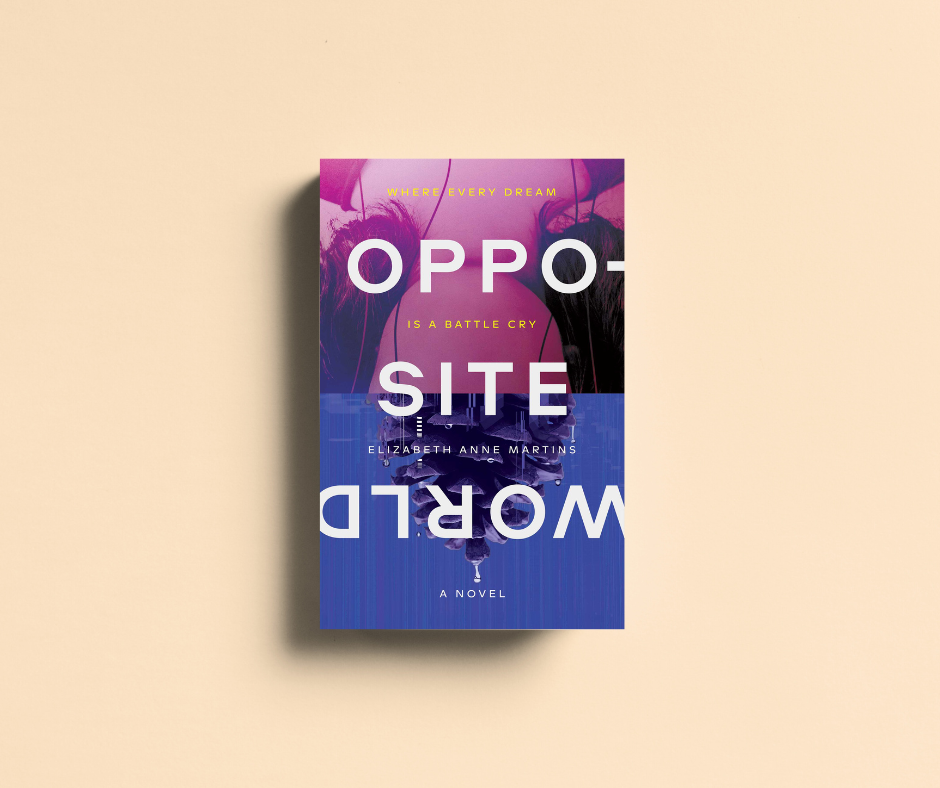
As technology becomes more and more intimate, promising not just convenience but emotional grounding, Opposite World asks a question: how much of our buried pain would we relive to finally uncover the truth?
In a near future Piper “Pip” Screed enters The Reverie Cloud—a sleep-state virtual therapy program that allows users to revisit and reshape their memories and live out their deepest desires within the safety of their own mind. For many it’s healing. For others it’s escape. For Pip, it’s both.
Still haunted by her mother’s mysterious death and the sixteen year gap that followed, Pip enters the program to find answers within her own subconscious. Inside, she meets versions of herself who are bold and fearless—opposite of the life she’s built in the real world. The deeper she goes, the more dependent she becomes on the program and the more reality begins to shift in the waking world.
Soon Pip can’t tell what’s real. Time bends, memories blur, and people she once trusted start to feel like threats. She realizes she isn’t a client at all—she’s an experiment.
Set between Seattle’s tech sector and the misty woods of Snoqualmie Pass, Opposite World turns the mind into landscape. Perfect for fans of Inception, Dark Matter, Eternal Sunshine of the Spotless Mind, Shutter Island, and Sea of Tranquility, it’s a perception-bending novel that reveals a different way of viewing the story on a second read.
Honors:
—Longlisted for the 2026 BSFA Award for Best Novel
—The Strand’s Science Fiction Pick of the Month (December, 2025)
Selected Reviews:
“A gripping, inventive and very human tech thriller.”
— SFX Magazine
“An articulate near-future Black Mirror-style take on loss and memory.”
— The Science Fact & Science Fiction Concatenation
“Martins has fun meticulously unpeeling the onion layers of Pip’s mind and showing how truth and trust can be malleable concepts.”
— Financial Times
“This is a story of trust, and a brilliant, unique journey into the vulnerabilities and insecurities of the self.”
— British Fantasy Society
“For fans of cutting-edge psychological terror replete with cultural fears.”
—Aurealis
“Thought-provoking…perfect for fans of mind-bending sci-fi like Inception.”
— Readworthy on BookBub
“Imaginative, sophisticated, and full of suspense.”
— Dr. Alice Violett, historian & book critic
Links:
The Strand
Simon and Schuster
BookShop.org
Barnes and Noble
Amazon
Amazon UK

In a world changed by a cataclysmic flood, a woman must trek across a lawless, predatory landscape to save her young son. Dry Lands is a visceral, high-stakes thriller about the ferocious limits of maternal love in a society that has completely unraveled.
Honors:
—Winner, Eric Hoffer Award for Best Fiction
—Women’s National Book Association — Great Group Reads Selection (2024)
Selected Reviews:
“A testament to the power of hope and motherhood in the worst of situations.”
— Kirkus Reviews
“Liv’s daily battle against starvation and predators, human and otherwise, is visceral, and—thanks to Martins’ gift for characterization—her evolution feels earned as she gradually adapts her ethics to keep Milo alive at all costs. The tenacious, well-shaded heroine elevates this above many similar efforts.”
— Publishers Weekly
“Liv and Milo now are on their own in a post-apocalyptic world where … survival is fueled by the pure love of a mother.”
— The US Review of Books
“Dry Lands includes the guns and action scenes one would expect in a dystopian, apocalyptic book or film … but also includes the everyday work mothers do … which … can be more of a challenge than shooting off the bad guy.”
— Grid Magazine
“A powerful feminist work of post-apocalyptic fiction” that offers “hope and the power of resolve.”
— Runalong The Shelves (book blog)
“A true stunner… one hell of a ride.”
— Jason Denness, independent literary reviewer (Best of 2024)
“A brilliant, character-led post-apocalyptic tale that is addictive and compelling from start to finish.”
— Me and My Books, independent literary review
Links:
Great Group Reads Pick by the Women’s National Book Association
Simon and Schuster
BookShop.org
Barnes and Noble
Amazon
Amazon UK
 Elizabeth Anne Martins